
The 2026 Black Friday Guide: The Ultimate Online Store Checklist
Black Friday is 27 November and Cyber Monday is 30 November. Here is what the numbers say, what to fix first, and a free checklist for your online store.
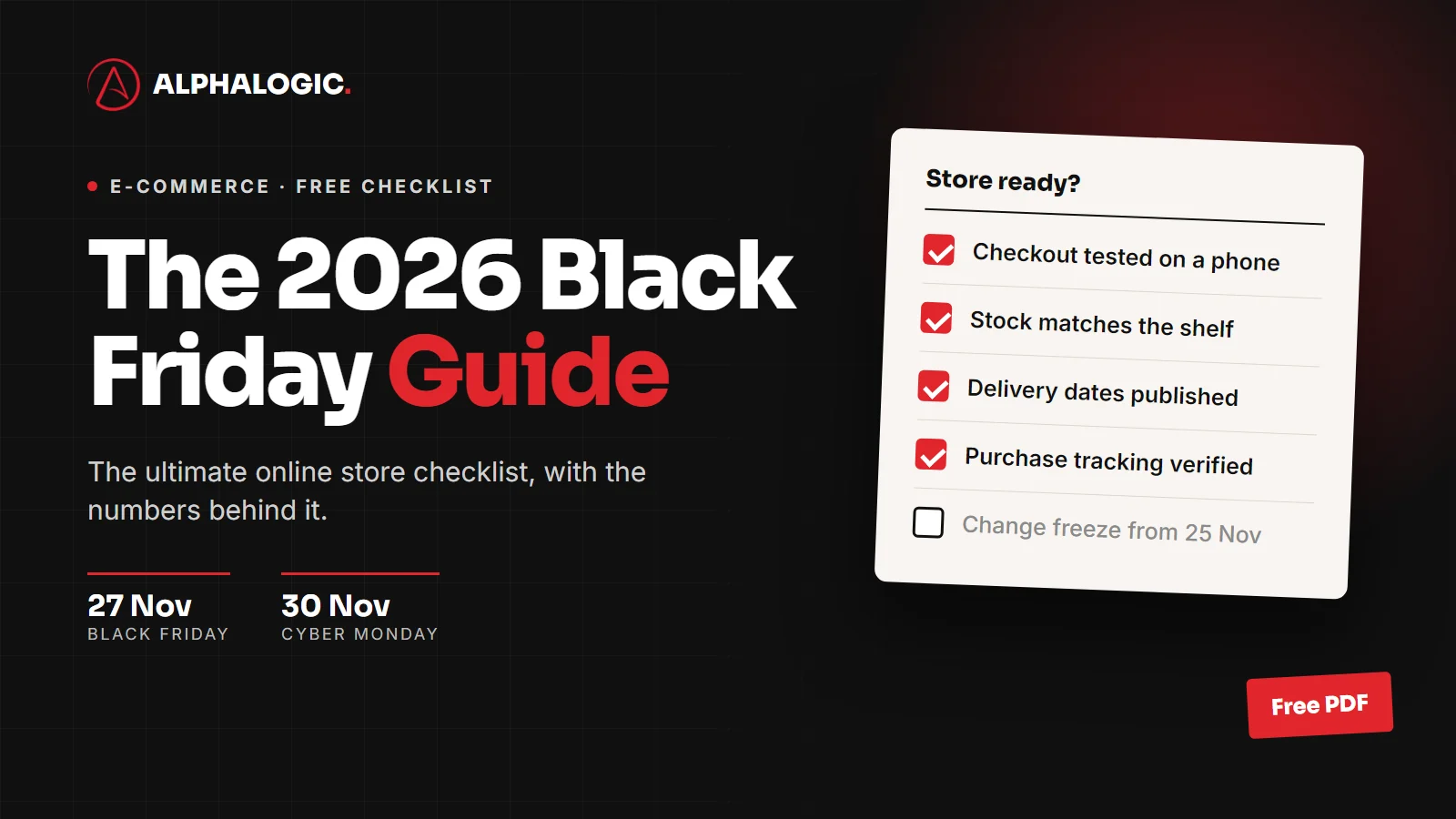
Black Friday is Friday 27 November 2026 and Cyber Monday is Monday 30 November. If you run an online store, you have 11 days.
That is enough time to fix the things that quietly lose sales. It is not enough to rebuild a store, so this guide does not pretend otherwise. It covers what the numbers say, what to check and in what order, and the mistakes we see most often. At the end there is a free checklist you can print and work through.
Free download: The 2026 Black Friday Online Store Checklist (PDF, 3 pages). 64 checks across 11 sections, from your offer to the day after the sale.
How many people shop online on Black Friday and Cyber Monday?
Most of the published figures are American, because Adobe and the National Retail Federation (NRF) track US shoppers closely. They are still the best picture we have of how the weekend behaves, so here they are, clearly labelled.
Last year, in the United States
- $14.25 billion was spent online on Cyber Monday 2025, up 7.1%. Adobe calls it the biggest online shopping day of all time.
- $11.8 billion was spent online on Black Friday, up 9.1%.
- $44.2 billion was spent online across Cyber Week, the five days from Thanksgiving to Cyber Monday, up 7.7%.
- 134.9 million people shopped online over that weekend, up 9% on the year before (NRF). On Black Friday itself 85.7 million shopped online, and on Cyber Monday 75.9 million.
- 57.5% of Cyber Monday online sales came through a phone, up from 41.4% five years earlier.
This year, as forecast by Adobe
- Cyber Week is forecast at $47.5 billion, up 7.4%.
- Black Friday is forecast at $12.9 billion (up 9.2%) and Cyber Monday at $15.1 billion (up 6.2%). Cyber Monday stays bigger, but Black Friday is growing faster.
- A record 63% of online spend on Thanksgiving Day is expected to come from phones. Across the whole season it is 57.4%.
These are forecasts, not results. We will know more on 1 December.
What about South Africa?
South African figures are patchier. Banks, payment providers and retailers each publish their own numbers, and no single audited national figure exists for the weekend. Here is what we can point to:
- Online retail is growing fast. World Wide Worx, working with Mastercard, Peach Payments and Ask Afrika, reports South African online retail grew 35% in 2024 to R96 billion, 8% of all retail. It expects more than R130 billion in 2025, close to 10% of retail.
- Baskets are getting bigger. PayFast reports an average Black Friday basket of R1,274 in 2025, up from R1,120 in 2024.
- Wallets are catching on. Cards and EFT still dominate, but In its Black Friday data PayFast saw Apple Pay grow 37% and Samsung Pay grow 31% year on year.
Online is still a minority of total retail in South Africa, but it is the part growing quickest, and the part you can do something about in 11 days.
What the numbers mean for a store your size
Black Friday is no longer one day. In the US, Black Friday has now grown faster than Cyber Monday two years running, because retailers start their discounts earlier. Adobe expects the same in 2026. Plan for the whole stretch: a teaser to your list a week ahead, a proper launch on the 27th, and a second push on Cyber Monday.
Your customer is on a phone. More than half of online sales now come through mobile, and the share keeps rising. If you have only ever tested your store on a laptop, you have not tested your store.
Shoppers want to pay their own way. Card, instant EFT and mobile wallets all matter. Every payment method you do not offer is a sale that goes to a competitor who does.
They are not only arriving from Google. Adobe reports that traffic from AI shopping assistants to US retail sites rose 670% on Cyber Monday 2025, and it expects a further 130% rise this season. The base is still small. But these tools read your product titles and descriptions, so vague ones now cost you twice.
The checklist, in the order we would do it
The PDF has all 64 checks. Here is why each group matters.
1. Fix your offer before you touch the design
A clever banner cannot rescue a discount that loses money. Check every price against your margin after payment fees, shipping and returns. Set exact start and end times. Cap quantities on your hottest deals so a hit product cannot outrun your stock.
Only show a "was" price you have actually charged. Misleading price claims break the Consumer Protection Act, and shoppers on Black Friday are quick to spot them.
2. Make it fast, and keep it up
A store that is slow on a normal Tuesday will struggle on a Friday with ten times the visitors. Load your home page, a product, the cart and checkout on a mid-range phone on mobile data. Run the key pages through Google PageSpeed Insights, compress your images, switch on caching, and ask your host what happens at 10 times your usual traffic. A CDN such as Cloudflare helps absorb the spike.
Set up uptime monitoring with an alert to your phone, and take a full backup before you freeze changes.
3. Make checkout boring
Checkout is where most sales are lost. Baymard Institute puts the average documented cart abandonment rate at about 70%. Some of that is people just browsing, but much of it is fixable. Among shoppers who left for a reason other than browsing, Baymard found:
- 40% said extra costs were too high (shipping, tax, fees).
- 20% said delivery was too slow.
- 19% did not trust the site with their card details.
- 18% were forced to create an account.
- 17% found checkout too long, and 17% hit errors or a crash.
These are US survey figures, but every one of them is something you can check on your own store. The fixes are plain: show the full cost early, offer guest checkout, keep the steps short, show your payment logos, and test every payment method with a real small payment, then refund it. Place a real order from your own phone, start to finish. It takes ten minutes and finds more problems than any report.
4. Be honest about stock and delivery
Overselling is the quickest way to turn a good weekend into a bad review. Reconcile your website stock against your shelf stock before the sale, and decide what happens when something sells out.
Publish courier cut-off dates for delivery before Christmas. Courier volumes slow down in peak week, so quote realistic delivery times and add a buffer. State your returns policy plainly: online sales generally carry a 7-day cancellation right under the Electronic Communications and Transactions Act (ECTA).
5. Check your tracking before the traffic arrives
If you spend money on ads, tracking is what tells you whether it worked. Place a test order and confirm that Google Analytics records the purchase with the right revenue, and that your Google Ads and Meta conversion tags fire. Tag every email, ad and social post with UTM parameters so you can see which one paid off. Send ad traffic to the offer page, not the home page. Get ads approved and budgets set before the 26th, because reviews can take days.
6. Line up the people side
Send an early-access teaser to your list 5 to 7 days ahead. Schedule the launch email and switch on abandoned-cart emails. Set up WhatsApp Business quick replies and an away message. Decide who answers customers and when, and write short answers to the five questions you get most: delivery, returns, payment, stock and discount codes.
7. Lock it down
Use strong admin passwords with two-factor sign-in, and remove old users. Update your platform and plugins at least a week ahead, then stop changing things. Turn on 3-D Secure and your gateway's fraud rules, and watch for odd or repeated large orders. Check that your privacy policy and cookie notice are current under POPIA, and publish your promotion terms: dates, "while stocks last" and a price-error clause.
8. Watch it, then learn from it
During the sale, check the site and a test checkout every few hours: morning, lunch and evening. Watch stock, failed payments and ad spend. Answer customers the same day. If something is not broken, do not change it.
Afterwards, reconcile orders against payments, ask for reviews once orders are delivered, and follow up buyers and abandoned carts with a Christmas offer. Write down what sold, what your margin was and where the traffic came from. That note is next year's head start.
A simple timeline for the next 11 days
- Now to 20 November: fix and test. Speed, mobile, checkout, tracking.
- 21 to 25 November: lock the offer, load the stock numbers, schedule emails and ads. Freeze changes from the 25th.
- 26 November: final checks. Test order on your phone, backup, confirm alerts reach you.
- 27 to 30 November: sell and monitor. Answer customers, watch stock.
- From 1 December: review the numbers and follow up buyers.
The mistakes we see most
- Changing the site in the final week. A new theme or plugin the day before is how checkouts break.
- Discounting below margin to "win" the day. A busy day that loses money is not a win.
- Sending ad traffic to the home page. Shoppers will not hunt for the offer.
- Never placing a real order on a phone. The most common problems are only visible there.
- Promising delivery before Christmas without checking courier dates.
- Forgetting Cyber Monday. It is still the biggest online day. Keep something fresh for it.
When to get help
If your checkout is slow, broken on mobile, or you are not sure your tracking works, get it looked at this week. Those are the fixes that pay for themselves quickly.
If you do not have an online store yet, be realistic: a properly built store by the 27th is a stretch. It is usually smarter to build it well for the Christmas and January trade, and use this weekend to learn what your customers do.
AlphaLogic builds and fixes websites and online stores for South African businesses. Business websites start from R4,950 and online stores from R18,500. If you would like a second pair of eyes on your store before the 27th, tell us what you sell and we will tell you what we would fix first.
Free download: The 2026 Black Friday Online Store Checklist (PDF). Print it, share it with your team, and work through it in order.
Sources
Figures are as published on 16 November 2026. US figures are US data.
- Adobe, Cyber Monday 2025 results and 2026 holiday forecast
- National Retail Federation, Thanksgiving weekend 2025
- World Wide Worx, Online Retail in South Africa 2025
- PayFast by Network, How South Africans shopped Black Friday 2025
- Baymard Institute, Cart abandonment rate statistics